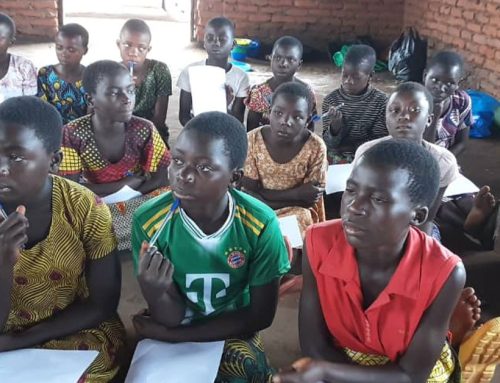
Within the beautiful landscape of the village of Chimpamp, Malawi, people stand together holding their new banana tree saplings. These plants arrived because of a successful, self-managed development project, and they represent nutrition and income. And they represent more than that—a new era of socioeconomic growth. As these neighbors gather, they smile and celebrate the arrival of something that may appear simple and of little consequence. But the process that leads to successes like these is complex. And the results are far-reaching and powerful.
These saplings are not just about nutrition and income. They’re about security. They’re about dignity—about a future shaped by the people who live there. They are one giant step in the middle of a long journey that will make life better for everyone through resilience, resourcefulness, and the power of community.
The First Step Toward Food Security
Community-Led Action in Chimpamp
For families throughout this region, food insecurity during the dry season is a long-standing challenge. And this is just one major aspect of the overall issue of poverty in Africa. But where some might resign themselves to scarcity, this community—guided by Outreach International facilitator Kelvin—saw this issue as a problem they could solve.
Kelvin has been working alongside the people of Chimpamp for about eight months, helping them explore and identify not only the problems they face, but their root causes. What emerged was a plan based on sustainability and simplicity: homestead fruit trees, starting with a banana tree project.
Recently, thanks to their own initiative, the community accessed 50 banana tree saplings from a surprising source—the Kasungu Prison Office, which maintains a large-scale banana farm through a government department. And like every Outreach project, the trees were not gifts—they were earned by the community organization through collaboration, networking, and persistent effort.

A Banana Tree at Every Home
Immediate Nutrition, Long-Term Vision
At this early stage in the banana tree project, 1–2 banana trees have been planted at each participating household. These trees will begin by providing fresh fruit for daily nutrition, but over time they will also build the foundation for something much larger.
Kelvin explains that the community’s vision is to eventually develop homegrown fruit tree groves, creating a reliable food source and, ultimately, a stream of income. Rather than trying to leap ahead to large-scale farming all at once, they’ve chosen to start small, while planning ahead with strategic intent that will make the results of this project sustainable into the future.

This method of beginning with modest, achievable steps is a hallmark of Outreach International’s community-led development methodology. It allows people to gain experience, build momentum, and develop confidence—all while seeing tangible results early in the process.
Nourishing the Soil—and the Spirit
Training in Mbeya Organic Fertilizer
Planting banana trees wasn’t the only recent development. Alongside this agricultural effort, community members have been trained in creating and using mbeya organic fertilizer, a nutrient-rich, locally-sourced soil treatment that improves crop yields without requiring expensive, synthetic additives.
This not only helps the banana saplings to take root and grow, but also increases the community’s overall capacity to maintain healthy gardens year-round. It’s another tool in their growing toolbox—a sign that knowledge, once shared, becomes an accelerator of progress.

From Saplings to Sustainability
A Scalable Vision for Prosperity
While these banana trees are still small, the community’s aspirations are anything but.
Kelvin shares that the group is already looking ahead to a much larger project—one that would include planting 1,950 banana trees on a single hectare of land, supported by a solar-powered irrigation system.
To make this vision a reality, the group researched these systems and obtained a detailed list of components this system would require:
- A borehole to access clean groundwater
- Solar panels
- Solar-powered pumping motors
- A submersible pump
- Pipes and fittings
- Large water storage tanks
It’s an ambitious plan, but it’s grounded in careful planning and local insight. The group understands that irrigation is the key to sustainable agriculture, especially in the face of climate-related droughts and an unpredictable growing season.
Fruit That Feeds—and Funds
Income Generation Potential
Beyond food security from the banana tree project, there is economic potential waiting to be unlocked. Once fully established, banana trees can reproduce through banana suckers—sprouts that grow into new trees that community members can learn to harvest and plant or sell as seedlings.
Each sucker can fetch an estimated $6.85 on the local market, meaning the community has the potential to generate up to $13,357 of income annually from a single hectare. This is an impressive amount that could fund future development projects, support families, and fuel the next wave of local ideas.

Community members celebrate their saplings.
It’s more than just a farming project—it’s a pathway toward economic freedom.
Development Takes Root
When Communities Lead, Progress Follows
The story unfolding in Chimpamp is about much more than banana trees. It’s about a group of people who chose to act—to come together, identify what they needed, and begin to build a better life for themselves and their families using the tools and knowledge available to them.
This is a shining example of the Outreach International process. We didn’t arrive in this community with donations, gifts, and handouts. We arrived with a framework—and the trust that people already hold the potential to find solutions to their own challenges. What we deliver is partnership, facilitation, and belief in their abilities.

Planting the Future
As each tree takes root in the earth of this community, something else is growing, too: hope, confidence, and a sense of shared purpose. With every passing season, these saplings will become more and more fruit-bearing trees. The families who planted them will harvest nourishment, sell new shoots, and continue building their vision for a better life. And we can’t wait to see what they accomplish next.
How to Help
Join the Movement
Help communities like Chimpamp plant their future—literally. Support Outreach International and be part of a global network that believes in the power of communities to lead their own transformation. Donate today. Empower the future.