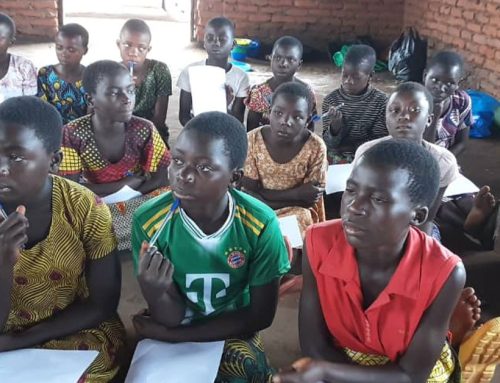
In India, 253 million people are age 10 to 19, making it the world’s biggest youth population. Because of this, development challenges ranging from employment shortages to limited or no access to healthcare affect youth disproportionately. But just as they face problems because of such challenges, they are also the solution. With technology at their fingertips and abounding youthful energy, they are an untapped development resource. When given opportunities to lead, young people can play a significant role in changing their communities’ social and economic well-being.

This is a story of such change. It involves youth from the rural community of Kuljing, Odisha, India, where access to improved sanitation has made a significant impact on their daily lives. And, they have also been directly involved in guaranteeing the ongoing success of sanitation in their community, ensuring that Kuljing becomes and stays open-defecation-free.

Community-Led Solutions
Jyoti is a 16 year old science student and member of the Kuljing Group, a community-based organization in Kuljing. Together with other community members, they practice community-led development. For the issue of sanitation, the CBO analyzed their challenges, sought a suitable solution for such challenges – in this instance, a community-led sanitation project – accessed the necessary funding, and then built 144 bathroom units between 2011 and 2017.

“We kept motivating people one day after another so that sanitation became important in people’s minds.” –Jyoti talking to community members
Creating Awareness, Ensuring Sustainability
But building these units is just the first step toward eradicating open defecation. Creating awareness about why people should continue to use their toilets is what has guaranteed the project’s success. Such awareness creation is where young people like Jyoti played a key role. Jyoti told us:
“We have a subject [in school] how to clean the environment, so we had some knowledge that [our community] must stop open defecation… So after we came to know that this is a problem in our village, all our studies came back to us. And we all started to discuss and we started to motivate others to use the toilets and told them about the benefits of the toilets and what happens when they don’t use toilets and go for open defecation.”
Creating awareness is easier said than done. It is a timely process, taking patience and commitment. Jyoti recalls that while motivating adult community members, one man was worried that “defecating near the house is a nasty thing” and was hesitant to use new and improved sanitation facilities. She responded to this by explaining that “he will get sick if he continues open defecation and his health would not [improve] if he didn’t use the toilets.” Jyoti noted, “this was not a one time process” but “after many attempts, he understood our concern.” She proudly reported that this community member still uses his bathroom.
Jyoti and other youth used a strategy that combined consistency and open discussion to help Kuljing community members understand why continued use of the bathrooms was indispensable to their individual well-being as well as Kuljing’s well-being.

Working Together; Seeing Results
The efforts of Kuljing’s youth toward securing long-term changes in sanitation is to the benefit of all Kuljing residents, including themselves. In a recent research study capturing the perceptions of Kuljing community members following the implementation of their sanitation project, some youth shared photos representing the change they have observed as a result of improved sanitation. Such results range from cleaner environments to greater privacy, especially for young women.
Youth also spoke of the greater sense of community that this project has built in Kuljing. Monjula took a photo of a bundle of sticks “because together the sticks symbolize the unity of the people.”

Youth: An Untapped Resource
Young people in Kuljing have shown that they are not only interested in participating in community development, but that they are also good at it. The community-led processes the Kuljing group used to address their most challenging poverty-related issues opened up opportunities for the community’s young people to rise to the occasion. Community-led processes are inclusive, creating space for all community members to participate in the development process. In the case of Kuljing, such participation was by the community’s young people patiently working with community members to change their perceptions and subsequent behaviors around sanitation. The time is ripe to bring young people onboard community interventions. They are ready.

Outreach International (OI) facilitates community-led development. In India, OI partners with an Odisha-based nonprofit, MGS who in turn supports the development of community-based organizations (CBOs), while strengthening the leadership skills of youth like Jyoti. With CBOs such as the Kuljing Group established, communities have the social infrastructure to plan for, and then implement community-led projects. These projects not only address communities’ most pressing poverty-related concerns but do so in a sustainable and locally-led way.